


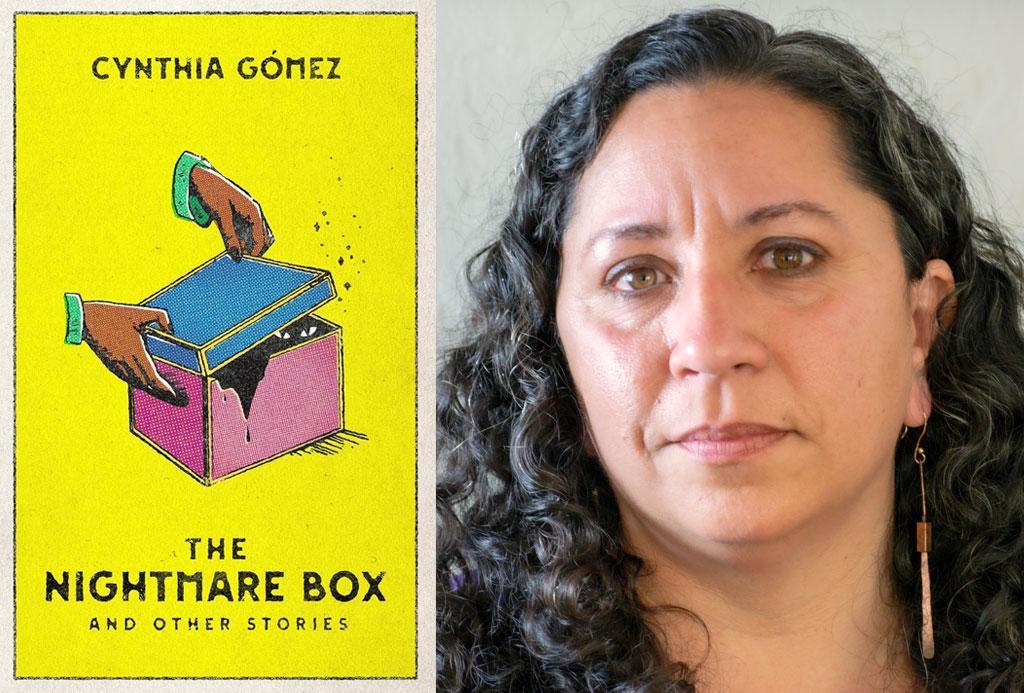
The Nightmare Box and Other Stories, by Cynthia Gómez | Cursed Morsels Press, 2024 | 213 pp.
Buy the book from Bookshop.org or Amazon
In The Nightmare Box and Other Stories, the first collection by Cynthia Gómez, Oakland, California, is haunted by a specter — the specter of hegemonic power. Racists, homophobes, the police (but as I said, racists and homophobes), handsy managers, and the latest in educational fads align against the supernatural, which is wielded as a weapon by the subaltern — people of color, workers, and queer folks.
At times, the stories serve primarily as wish fulfillment. In “A Kiss to Build a Dream On,” a young man named Eddie enters the gay underground of the post-WWII/pre-Stonewall era. Though his mother is accepting, society is not. A magic shop gives him a powerful set of clothes that let him beat the crap out of some police. Yay! But also, so? “Lips Like Sugar” is more interesting; Gómez’s depiction of third-shift jobs is well observed. She knows how a working-class vampire might make it through the night on minimum wage, but Vivi is a very good vampire who only day(night?)dreams of vengeance. “Will They Disappear” serves as an outright correction to the horrific Hart family murders. Indeed, if only one of those children had had magical abilities. I want that too.
“Huitzol and the Rope of Thorns” is the best of the stories with this theme: it’s not just by a writer interested in giving marginalized protagonists the power to strike back against oppression, it is about such a writer, who then gets to be a supernatural protagonist. The titular papier-mâché god likes television and is a bit of a nuisance around the house, keeping the tale from becoming too dour.
The more powerful stories complicate the supernatural. “The Road out of Nowhere” is about wrong turns and roads not taken — vengeance isn’t easy, and sometimes not worth the sacrifice. There’s especially excellent writing in this one, such as when Emilio gets the chance to enter a time-slip. “In the lot in front of him it was as if the film reel had slipped, as if the song were caught between two radio stations.”
The apex achievement of The Nightmare Box is “Someone Else’s To Destroy” — how can one protect one’s children against police violence? Sometimes the sacrifice is made, and made selfishly. Imagine if “Jeffty Is Five” was an exercise in exploring motherly love, racial oppression, and the hard limits of middle-class assimilation, instead of whatever radio programs Harlan Ellison was nostalgic about.
Gómez captures the spirit of Oakland, perhaps the most political and politicized city in the United States, with aplomb. The music cues are always right, every apartment is the correct size, the radicalism of the streets and the relationships within extended families are all spot-on. We do not yet have a great Oakland novel, and sadly the closest is probably East Bay Grease by right-wing crank Eric Miles Williamson. I hope Gómez will soon get to work on correcting this artifact of white hegemonic power and write us the ultimate Beast — “East Bay” in Pig Latin — novel, with plenty of its horrors repurposed as tools of liberation.

Leave a Reply